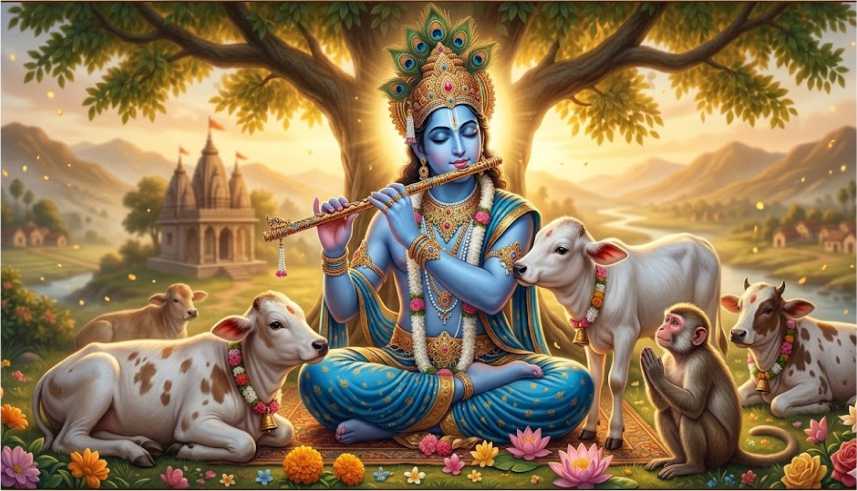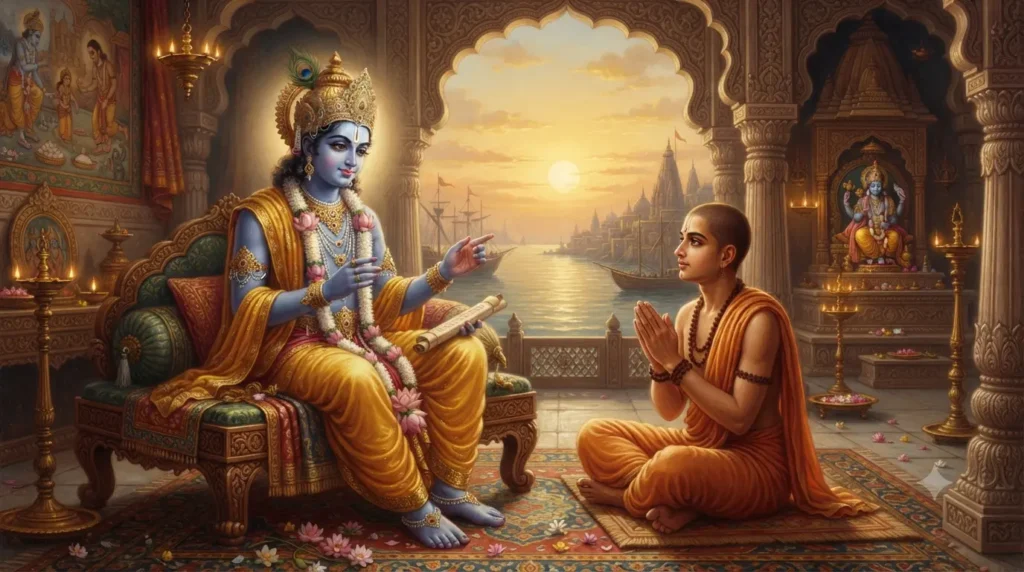
The Uddhava Gita tells the story of a time when Lord Krishna’s divine pastimes on Earth were approaching their end. Uddhava, one of Krishna’s dearest companions in Dwarka, was deeply saddened by the thought that he would soon have to be separated from his beloved Lord. Uddhava did not want to go anywhere without Krishna. He prayed to the Lord to take him along to His divine abode.
However, instead of taking Uddhava with Him, Lord Krishna imparted such profound spiritual wisdom that it would transform the direction of his entire life.
This long and profound conversation is known as the Uddhava Gita. It appears in the Eleventh Canto of the Shrimad Bhagavata Mahapurana. Through His answers to Uddhava’s questions, Lord Krishna explained devotion, spiritual knowledge, detachment, the mind, the senses, the material world, the soul, and the path to attaining God.
Uddhava Was Heartbroken Upon Hearing That Lord Krishna Would Depart
The time had arrived in Dwarka when circumstances surrounding the end of the Yadu dynasty were unfolding. Lord Krishna knew that His divine pastimes on Earth were nearing their conclusion.
Uddhava was very close to Lord Krishna. When he received indications of the Lord’s impending departure, he found it impossible to control his emotions.
He went to Lord Krishna and expressed his deepest sorrow. His feelings were simple: if the Lord Himself was going to leave the Earth, how could he possibly live without Him?
The Sixth Chapter of the Eleventh Canto of the Shrimad Bhagavata describes this episode. Deeply distressed by the thought of separation from Lord Krishna, Uddhava requests the Lord to take him along.
This is where we begin to understand the emotional background of the Uddhava Gita.
It was not merely a conversation between a teacher and a disciple.
It was the heartfelt anguish of a devotee who did not want to be separated from the Lord he loved most.
What Did Uddhava Ask of Lord Krishna?
Uddhava wanted Lord Krishna to take him along to His divine abode.
However, Lord Krishna explained that he still had an important responsibility to fulfil.
He needed to understand the spiritual wisdom imparted by the Lord and then travel to Badrikashram.
Therefore, Krishna did not simply tell Uddhava, “Do not worry.”
Instead, He began answering the deepest questions troubling his mind:
- How can a person remain free from attachment while living in the material world?
- How can one control the senses?
- How can one remain balanced in happiness and sorrow?
- How can one attain God?
- How does true detachment develop?
- Why do people become so attached to worldly things when everything in the material world is temporary?
- Most importantly, when the Lord is no longer physically present, how can a devotee maintain a connection with Him?
Lord Krishna answered these questions in great detail.
Lord Krishna Explained That a Person Can Find Gurus in Everyday Life
Uddhava raised an important difficulty before Lord Krishna. It is extremely challenging for someone living in the material world to remain free from worldly attractions and desires.
Lord Krishna then explained a beautiful principle.
A person can gain spiritual wisdom by observing the events and experiences of everyday life.
To illustrate this teaching, Lord Krishna narrated the ancient story of King Yadu and an Avadhuta Brahmin.
King Yadu once encountered an Avadhuta whose behaviour deeply impressed him. The ascetic did not appear attached to any particular external possession or arrangement, and a unique sense of peace could be seen within him.
King Yadu asked him where he had acquired such wisdom and inner peace.
The Avadhuta replied that he had 24 gurus.
These gurus were not individual spiritual teachers or religious scholars.
Instead, he had learned different lessons about life from the Earth, air, sky, water, fire, Moon, Sun, birds, animals, bees, ocean, child, young woman, snake, spider, and other elements of nature and life.
What Did He Learn from the Earth?
The Avadhuta learned patience and endurance from the Earth.
People walk upon the Earth, dig into it, build structures on it, and use it in countless ways. Yet the Earth continues to bear everything with remarkable patience.
Similarly, human beings should learn to remain patient when facing difficult circumstances in life.
Responding immediately to everything or becoming discouraged by every problem only makes life more difficult.
What Did He Learn from the Air?
Air passes through different places without becoming attached to any particular object.
This teaches us that even while living in the material world, we should avoid excessive attachment.
Family, wealth, homes, and relationships are important parts of life, but considering them the ultimate truth can eventually become a source of suffering.
What Did He Learn from the Python?
The Avadhuta learned contentment from the python.
A python does not constantly wander around searching for food. It remains content with whatever becomes available.
This does not mean that people should stop working hard.
Rather, it teaches us to avoid excessive greed and the constant restlessness of wanting more and more.
What Did He Learn from the Honeybee?
A honeybee collects small quantities of nectar from different flowers.
The Avadhuta learned an important lesson about the tendency to accumulate possessions.
Human beings can spend their entire lives collecting wealth and material things. However, in the end, they cannot take everything they have accumulated with them.
Therefore, it is important to understand the difference between genuine needs and greed.
The Important Lesson Learned from Pingala
The episode of Pingala is particularly moving in the Uddhava Gita.
Pingala was a woman who was waiting for someone to arrive. She continued hoping that the person would come, but her expectations were never fulfilled.
After waiting for a long time and experiencing disappointment, a profound thought arose in her mind.
She realised that the very expectation she had placed in something outside herself had become the cause of her suffering.
When she finally abandoned that expectation, she experienced a sense of inner peace.
This episode is also closely connected to modern life.
Sometimes, our suffering comes less from the actual circumstances and more from the expectations we create.
We want someone to behave according to our wishes, a situation to unfold exactly as we desire, or an outcome to match our expectations.
When things do not happen that way, our minds become disturbed.
The story of Pingala teaches us that letting go of excessive expectations can also be a path to inner peace.
What Did He Learn from the Kurara Bird?
A Kurara bird was flying with something held in its beak. Other birds began chasing it.
When it finally released the object, the other birds stopped pursuing it.
The Avadhuta understood that sometimes holding on to something becomes the very cause of conflict.
Similarly, people become so attached to wealth, possessions, status, or their own opinions that they lose their inner peace.
Sometimes, letting go is not a defeat.
Sometimes, letting go is the very thing that brings peace.
What Did He Learn from a Child?
The Avadhuta learned simplicity and naturalness from a child.
A child often does not become overwhelmed by worries about the future. It remains naturally present in the moment.
As people grow older, they become trapped between the past and the future.
They remember old experiences and become unhappy, or worry about what lies ahead and become anxious.
Therefore, simplicity and awareness of the present moment are also important in life.
The Lesson of Concentration from an Arrow Maker
The Avadhuta once observed an arrow maker who was so deeply absorbed in his work that he did not even notice the activities happening around him.
From this, he learned the importance of concentration.
This teaching seems even more relevant today.
Between mobile phones, social media, constant notifications, and countless worries, the mind often struggles to remain focused on one thing.
This teaching of the Uddhava Gita reminds us to learn how to give our full attention to whatever work we are doing.
What Did He Learn from the Snake?
A snake does not become concerned with building a permanent home of its own and settling down in it.
The Avadhuta learned from this to avoid excessive accumulation and attachment to permanent arrangements.
The underlying lesson is that we should fulfil our genuine needs without making unnecessary accumulation the purpose of our lives.
What Did the Spider Teach Him?
A spider creates its web from its own body and eventually withdraws it back into itself.
The Avadhuta reflected on the nature of creation through this natural phenomenon.
The purpose of the entire story narrated by Lord Krishna was to explain that a person with spiritual understanding can learn valuable lessons from the world around them.
Uddhava Then Asked Lord Krishna Another Important Question
Uddhava’s curiosity did not end there.
He asked Lord Krishna about the many paths prescribed for human welfare, including spiritual knowledge, yoga, austerities, religious disciplines, and devotion.
Among all these paths, which one is the most important?
In the Fourteenth Chapter of the Eleventh Canto of the Shrimad Bhagavata, Uddhava raises a question of this nature, asking Lord Krishna which spiritual practice is the highest among the many paths that lead to human welfare.
In Krishna’s teachings, devotion (Bhakti) holds a particularly important place.
Devotion to God is not limited to performing rituals and worship.
Its true essence lies in dedicating one’s mind, speech, and actions to the Lord, remembering Him, and developing sincere love for Him.
Lord Krishna Did Not Tell Uddhava to Abandon the World
This is a very important point to understand.
Although the Uddhava Gita discusses detachment, detachment does not simply mean leaving one’s family and home.
The real teaching is that a person can fulfil worldly responsibilities without becoming excessively attached to them internally.
A person can live with their family.
They can work.
They can earn money.
They can fulfil their responsibilities towards society.
However, they should understand that none of these things will remain with them forever.
When this understanding develops within, attachment gradually begins to decrease.
What Did Lord Krishna Teach About the Mind and Senses?
The mind is naturally restless.
When one desire is fulfilled, another desire arises.
When a person acquires one thing, the longing for something else begins.
If someone keeps chasing every desire of the mind, finding contentment becomes difficult.
Therefore, Lord Krishna taught Uddhava the importance of controlling the mind and senses.
This discipline does not mean forcibly giving up everything.
Rather, it means understanding that not every desire needs to be fulfilled.
A person who learns to observe and understand their own mind gradually becomes less of a slave to their desires.
Lord Krishna Explained the Simple Path of Devotion
In the concluding portions of the Uddhava Gita, Lord Krishna explains devotion in a simple and practical manner.
- Serve the Lord.
- Remember the Lord.
- Respect the sacred places associated with the Lord and His devotees.
- Celebrate festivals in honour of the Lord.
- Dedicate your actions to Him.
- Most importantly, try to recognise the presence of God in all living beings.
Through these practices, devotion does not remain limited to the temple.
A person’s everyday behaviour also becomes an expression of their devotion.
If someone worships God in a temple but continues to harbour hatred and arrogance towards others outside, the sense of equality taught by Lord Krishna has not yet fully entered their life.
Lord Krishna Asked Uddhava: Has Your Attachment Disappeared?
After explaining all these teachings, Lord Krishna asked Uddhava a very important question.
He said:
“Apy Uddhava Tvaya Brahma Sakhe Samavadharitam
Api Te Vigato Mohah Shokash Chasau Manobhavah”
Meaning:
“O My dear friend Uddhava! Have you understood this spiritual knowledge? Have the attachment and sorrow arising in your mind now disappeared?”
This question carries a profound message.
Lord Krishna had not simply shared a large amount of information with Uddhava.
He wanted to know whether these teachings had helped remove the inner pain that had led Uddhava to seek this knowledge.
In other words, the true purpose of spiritual knowledge is not merely to increase information.
Its purpose is to:
- Reduce attachment.
- Remove confusion.
- Bring peace to the mind.
- Strengthen love and faith in the Lord.
Where Did Lord Krishna Ask Uddhava to Go?
Lord Krishna instructed Uddhava to travel to Badrikashram.
He told Uddhava to live a disciplined life there, accept the natural food available to him, control his senses, remain peaceful, and contemplate the spiritual wisdom he had received from Krishna.
The Lord specifically instructed him to keep his mind and speech focused on Him and to follow the path of righteousness taught by Him.
This instruction was extremely difficult for Uddhava.
The very Lord from whom he did not want to be separated was now instructing him to leave.
The Emotional Farewell of Uddhava
For Uddhava, separating from Lord Krishna was not easy.
According to the account in the Shrimad Bhagavata, Uddhava was deeply overwhelmed by the thought of separation from Krishna. He repeatedly offered his obeisances to the Lord and placed the Lord’s sandals upon his head. Then, following Krishna’s command, he departed.
This is one of the most emotional moments in the Uddhava Gita.
Uddhava was physically leaving Lord Krishna, but he carried the Lord’s memories and teachings within his heart.
Later, Uddhava reached Badrikashram and devoted himself to austerities and spiritual practices according to the Lord’s instructions.
What Does the Uddhava Gita Teach Us?
Rather than reading the Uddhava Gita merely as a religious story, when we connect its teachings with everyday life, many of its lessons seem remarkably practical and relevant even today.
First Lesson: Nothing Is Permanent.
The things that trouble us greatly today can also change with time.
Second Lesson: Not Every Desire Needs to Be Fulfilled.
Constantly chasing every demand of the mind does not bring lasting peace.
Third Lesson: Excessive Expectations Bring Suffering.
The story of Pingala explains this lesson in a very simple way.
Fourth Lesson: We Can Learn from Every Experience in Life.
The story of the 24 gurus teaches us precisely this.
Fifth Lesson: Detachment Does Not Mean Abandoning Responsibilities.
We can live in the world while keeping our minds focused on God.
Sixth Lesson: Devotion Is More Than Worship.
Remembering God, serving Him, surrendering to Him, practising self-discipline, and respecting all living beings are also expressions of devotion.
And the Greatest Lesson: The Purpose of Knowledge Is to Transform the Mind.
If the mind remains trapped in the same attachments, ego, and restlessness even after gaining considerable knowledge, that knowledge has not yet been fully put into practice.
Conclusion
The Uddhava Gita is a profound conversation between Lord Krishna and Uddhava, in which a devotee, overwhelmed by the pain of separation from his beloved Lord, receives the deepest wisdom about life.
Uddhava did not want to leave Lord Krishna. He wanted to accompany Him. However, Lord Krishna explained that he now needed to move forward with the spiritual knowledge he had received.
The Lord taught him that the material world is constantly changing, the mind and senses must be disciplined, unnecessary expectations and attachments should be reduced, and every situation in life should be approached with a willingness to learn.
Through the story of the 24 gurus, Lord Krishna demonstrated that everything from the Earth, air, water, and fire to birds, animals, and ordinary human beings can become our teachers if we develop the right perspective.
Finally, Lord Krishna showed Uddhava the path of devotion, surrender, and keeping the mind absorbed in the remembrance of God.
When Krishna asked whether Uddhava’s attachment and sorrow had disappeared, the true purpose of the entire conversation became clear:
The wisdom of God is not merely meant to be heard. It is meant to remove attachment from the mind and transform the way we live.
This is the greatest teaching of the Uddhava Gita.