Introduction to Chhath Puja 2026
Chhath Puja holds a special place in India’s religious and cultural traditions. It is a major festival dedicated to the worship of Lord Surya, the Sun God, and the expression of devotion towards Chhathi Maiya. This festival is not limited to prayers and religious rituals; it also embodies self-discipline, purity, family unity and gratitude towards nature.
Chhath Puja is primarily celebrated with great enthusiasm in Bihar, Jharkhand, eastern Uttar Pradesh and the Terai region of Nepal. Over time, the festival has also spread to other parts of India and to Indian communities living abroad. Every year, large numbers of devotees gather along rivers, ponds and specially arranged water bodies in cities such as Delhi, Mumbai, Kolkata, Lucknow and Noida.
Chhath Puja is a four-day festival observed with great devotion and discipline. It begins with Nahay Khay, followed by Kharna on the second day. On the third day, devotees offer Sandhya Arghya to the setting Sun. On the fourth day, they offer Usha Arghya to the rising Sun before completing their fast.
In 2026, Chhath Puja will be observed from Friday, 13 November to Monday, 16 November. The main day of the festival, including Sandhya Arghya, will fall on Sunday, 15 November.
One of the most distinctive aspects of Chhath is that the setting Sun is honoured with the same devotion as the rising Sun. This tradition reminds devotees to respect every stage of life and to maintain hope even during difficult circumstances.
Chhath Puja 2026: Dates and Four-Day Schedule
According to the Hindu lunar calendar, Chhath Puja is observed during the Shukla Paksha of the month of Kartik. Its four-day observance traditionally begins on Kartik Shukla Chaturthi and concludes on Saptami. Shashthi Tithi is the main day of the festival, which is why Chhath is also known as Surya Shashthi Vrat.
The schedule for Chhath Puja in 2026 is as follows:
| Day | Date | Weekday | Ritual |
|---|---|---|---|
| First Day | 13 November 2026 | Friday | Nahay Khay |
| Second Day | 14 November 2026 | Saturday | Kharna and Lohanda |
| Third Day | 15 November 2026 | Sunday | Sandhya Arghya |
| Fourth Day | 16 November 2026 | Monday | Usha Arghya and Paran |
Each day of this festival has its own religious and spiritual significance. On the first day, devotees focus on cleanliness and the preparation of their homes. On the second day, they observe a fast and prepare the traditional offerings. On the third day, Arghya is offered to the setting Sun, while on the fourth day, devotees offer prayers to the rising Sun and complete their fast.
The dates of Chhath Puja are determined according to the Hindu lunar calendar. Sunrise and sunset times vary from one location to another. Devotees should therefore consult a reliable local Panchang for the timings applicable to their area.
What Is Chhath Puja?
Chhath Puja is an ancient folk festival associated with the worship of Lord Surya and Goddess Shashthi. It is also known as Chhath Mahaparv, Surya Shashthi, Dala Chhath and the festival of Chhathi Maiya.
In Indian tradition, the Sun is regarded as one of the foundations of life. Sunlight and solar energy are essential for life on Earth. The Sun plays an important role in agriculture, plant growth, the water cycle and everyday human life. For this reason, Indian culture honours the Sun not merely as a celestial source of light but also as a life-giving deity.
Chhath Puja is a religious and cultural expression of gratitude towards the Sun and nature.
During this festival, devotees follow strict rules and perform the rituals with great discipline. Special attention is given to the purity of food, cleanliness, self-restraint and mental discipline. From preparing the offerings to performing Arghya, every activity is carried out with devotion and care.
Traditionally, women observe this fast in large numbers, but men can also observe Chhath Vrat. In many families, men participate in the rituals with equal dedication.
Chhath Puja does not require grand temples or elaborate displays. Devotees offer Arghya to the Sun beside a river, pond, lake or other suitable water body. This simplicity is one of the distinctive features of the festival.
Religious and Spiritual Significance of Chhath Puja
The significance of Chhath Puja is not limited to prayers for the happiness and prosperity of children. The festival also reminds people of their responsibilities towards nature, family and society.
1. Gratitude Towards Lord Surya
Life on Earth cannot be imagined without sunlight and solar energy. The Sun plays an important role in plant growth, agricultural production and the natural cycles that sustain life.
During Chhath, devotees offer water to Lord Surya as an expression of respect and gratitude. This worship reminds us to value the natural resources and benefits that we receive from nature.
2. The Message of Purity and Self-Discipline
Cleanliness is given great importance during Chhath Vrat. Cleaning the home, keeping the worship materials clean and following traditional rules while preparing food are important parts of the festival.
Devotees follow a disciplined daily routine and practise restraint in their food, behaviour and thoughts. In this way, Chhath is not merely a religious ritual but also an observance that encourages self-discipline.
3. Prayers for the Well-being of Children
According to popular tradition, Chhathi Maiya is regarded as the Goddess who protects children. Many families observe this fast to pray for the good health, long life and bright future of their children.
Parents seek the blessings of Goddess Shashthi and Lord Surya for the happiness and well-being of their children.
4. Family and Social Unity
Almost every member of the family participates in Chhath Puja in one way or another. Some prepare the offerings, others arrange the worship materials, while others help organise the riverbank or ghat.
The festival brings people from different social and economic backgrounds together. Devotees gather at the ghats to offer prayers to Lord Surya and take part in the celebrations.
5. Respect for Nature and the Environment
Bamboo baskets, fruits, coconuts, sugarcane and other natural materials are used during Chhath Puja. Water bodies and the Sun are at the centre of the worship.
The festival conveys a message of respect for nature. In modern times, it is equally important to ensure that plastic, rubbish and other waste are not left in rivers, ponds or other water bodies after the rituals.
Mythological Background of Chhath Puja
To understand the traditions associated with Chhath Puja, it is useful to learn about the religious beliefs connected with Sun worship and Goddess Shashthi. Ancient Hindu scriptures describe the glory of the Sun, while Puranic traditions include stories of Goddess Shashthi and her association with the protection and well-being of children.
It is important to understand that not every present-day folk custom associated with Chhath Puja appears in exactly the same form in a single ancient scripture. The festival has developed over time through the combination of Vedic Sun worship, Puranic devotion to the Goddess and regional folk traditions.
Importance of Lord Surya in the Vedic Tradition
In the Vedas, the Sun is praised as a source of light, energy and life. The Rigveda contains several hymns dedicated to the Sun. Surya is described as the illuminator of the world and a deity closely connected with the lives of all living beings.
A well-known mantra from the Rigveda describes the glory of the Sun:
Chitram devanam udagad anikam chakshur mitrasya varunasyagneh.
Apra dyavaprithivi antariksham surya atma jagatas tasthushash cha.
— Rigveda 1.115.1
Simple Meaning: The magnificent light of the Sun has appeared in the sky. The Sun is described as the eye of Mitra, Varuna and Agni. Through its light, the Sun illuminates the heavens, the Earth and the space between them. The Sun holds a special place in the lives of all moving and stationary beings.
This mantra expresses the vast significance of the Sun in the natural world.
In Indian tradition, offering water to the Sun every day is also a common practice. Paying respects to the Sun in the morning, performing Surya Namaskar and reciting mantras associated with Aditya are among the traditional forms of Sun worship.
Chhath Puja can be understood as a distinctive folk tradition within this broader tradition of reverence for the Sun.
The Story of Goddess Shashthi and King Priyavrata
One of the important Puranic stories associated with Goddess Shashthi appears in the Prakriti Khanda of the Brahma Vaivarta Purana. In this account, the Goddess is described as a divine power associated with the protection of children and the well-being of families.
According to the story, King Priyavrata, the son of Svayambhuva Manu, and his wife Malini wished to have a child. However, they remained without children for a long time. Seeking the blessing of a child, the King performed a Yajna under the guidance of Sage Kashyapa.
After the Yajna, Queen Malini became pregnant, but the child was born lifeless. The King and Queen were deeply distressed. Overcome with grief, King Priyavrata began mourning while holding his child.
At that moment, a divine Goddess appeared. She introduced herself as Goddess Shashthi. In this Puranic tradition, she is associated with Brahma and is also known as Devsena.
Through the grace of the Goddess, the lifeless child was restored to life. The King praised the Goddess and expressed his gratitude. She then explained the significance of her worship to him.
Through this story, Goddess Shashthi came to be revered as a Goddess who protects children and blesses families with the happiness of having offspring.
In the folk traditions of northern India, this Goddess is worshipped with great devotion as Chhathi Maiya.
The Story of the Akshaya Patra and Lord Surya in the Mahabharata
The Mahabharata contains an important story associated with Lord Surya and the divine Akshaya Patra.
During their exile in the forest, the Pandavas were accompanied by many sages and guests. With their limited resources, arranging food for everyone became difficult. To find a solution, Yudhishthira sought guidance from his priest, Sage Dhaumya.
Sage Dhaumya advised him to worship Lord Surya. Yudhishthira offered prayers to the Sun God with complete devotion.
Pleased with his devotion, Lord Surya presented him with the divine Akshaya Patra. This miraculous vessel had the special quality of providing food in abundance until Draupadi had eaten for the day.
In this way, the Pandavas received help in arranging food for their family and guests during their exile.
This story presents Lord Surya as a source of food, nourishment and life. However, although the story of the Akshaya Patra appears in the Mahabharata, it should not be treated as direct scriptural evidence for every ritual performed during modern Chhath Puja.
Karna, the Son of Lord Surya, and Sun Worship
According to the Mahabharata, Karna was the son of Lord Surya. He was born through the divine boon granted to Kunti, which resulted in his birth through the grace of the Sun God.
Karna was renowned for his brilliance, generosity and courage. His connection with Lord Surya is an important part of the traditional accounts of the Mahabharata.
A popular belief holds that Karna regularly worshipped the Sun and offered Arghya while standing in water.
For this reason, some folk stories associate Karna with the tradition of Sun worship. However, the claim that Karna was directly responsible for establishing modern Chhath Puja is not historically established.
Sun Worship by Samba, the Son of Lord Krishna
Samba was the son of Lord Krishna. A well-known religious tradition associated with him concerns the worship of Lord Surya and a story of recovery from illness.
According to a popular traditional account, Samba suffered from leprosy. He worshipped Lord Surya and, through the grace of the Sun God, was cured of the illness.
Because of this story, Lord Surya is also associated in religious traditions with health and healing.
India has several ancient centres of Sun worship. The Konark Sun Temple in Odisha and the Deo Sun Temple in Aurangabad district of Bihar are important cultural heritage sites associated with this tradition.
The Folk Belief Associated with Lord Rama and Goddess Sita
A popular belief in Bihar and the Purvanchal region holds that after returning to Ayodhya following their victory in Lanka, Lord Rama and Goddess Sita worshipped Lord Surya.
Some regional folk stories also state that Goddess Sita offered Arghya to the Sun God on the occasion of Kartik Shukla Shashthi.
This story is part of regional religious traditions and folk beliefs. However, it should not be presented as a historically established event described in the original text of the Ramayana.
Thus, the stories associated with Chhath are found in different religious and cultural traditions. Their central message is devotion towards Lord Surya and Goddess Shashthi, prayers for the well-being of the family and gratitude towards nature.
Who Is Chhathi Maiya?
Along with Lord Surya, the worship of Chhathi Maiya holds special significance during Chhath Puja. According to popular belief, Chhathi Maiya is the Goddess who protects children, blesses families with offspring and looks after their well-being.
Goddess Shashthi is mentioned in Puranic traditions. She is described as a divine power associated with the protection of children, the blessing of offspring and their good health.
One popular folk belief is that Chhathi Maiya is worshipped on the sixth day after a child’s birth. This ceremony is known as Chhathi or Chhathiyar.
According to tradition, prayers are offered for the child’s life and future on the sixth day after birth. In some regions, there is also a belief that Vidhaata writes the child’s destiny on that night.
Because of this folk belief, Chhathi Maiya is also referred to as Vidhaata Mata in some places.
However, it is more appropriate to understand the name Vidhaata Mata as a regional folk expression rather than a universally accepted scriptural name of Goddess Shashthi.
During Chhath, women pray to the Goddess for the happiness, prosperity, health and long life of their children. Families who wish to have children also place special faith in this fast.
Chhath Puja 2026: Auspicious Timings and Arghya Muhurat
Sunset and sunrise have special importance during Chhath Puja. On the third day, Arghya is offered to the setting Sun in the evening. On the following morning, Usha Arghya is offered to the rising Sun.
The following are approximate sunrise and sunset timings for Ghaziabad in 2026:
| Ritual | Date | Approximate Time |
|---|---|---|
| Sandhya Arghya | 15 November 2026 | Sunset at approximately 5:26 pm |
| Usha Arghya | 16 November 2026 | Sunrise at approximately 6:43 am |
These timings are approximate and apply to Ghaziabad. Sunrise and sunset times may differ slightly in Delhi and other parts of the National Capital Region, as well as in other cities. Devotees should check their local Panchang for location-specific timings.
There is no single universal clock time prescribed for offering Arghya during Chhath. Sandhya Arghya is offered around sunset, while Usha Arghya is offered around sunrise.
Complete Chhath Puja Vidhi: The Four-Day Tradition
Chhath Puja is a four-day spiritual observance. Each day has its own rituals, offerings and religious significance.
Day One: Nahay Khay
The first day of Chhath Mahaparv is known as Nahay Khay. In 2026, it will be observed on Friday, 13 November.
On this day, devotees wake up early in the morning and clean their homes. They then bathe in a river, pond or other clean water body and take a vow to observe the festival.
Where a river or pond is not available, devotees may also bathe at home and prepare for the worship according to their family traditions.
Special attention is given to the purity of food on Nahay Khay. Traditionally, a meal consisting of pumpkin curry, chana dal and Arwa rice is prepared on this day.
Cleanliness and purity are carefully maintained while preparing the food. In many families, the meal is cooked in earthen or new cooking vessels.
On this day, devotees eat a pure and simple meal and begin preparing for the remaining rituals of Chhath.
The central message of Nahay Khay is that every spiritual practice should begin with both external and inner purity.
Day Two: Kharna and Lohanda
The second day of Chhath Puja is known as Kharna or Lohanda. In 2026, it will be observed on Saturday, 14 November.
Devotees observe a fast from the morning onwards. They do not eat during the day and, in the evening, perform worship of Lord Surya and Chhathi Maiya after bathing.
Special Prasad is prepared for Kharna. It mainly includes kheer made with jaggery, known in many regions as Rasiyaw, and roti made from wheat flour.
In some places, there is a tradition of preparing this Prasad on a new earthen stove using mango wood. Great care is taken to maintain cleanliness and purity while preparing the offerings.
In the evening, devotees perform the worship and then consume the Prasad. Other family members also receive it with devotion.
After Kharna, the approximately 36-hour waterless fast begins for those who follow this traditional observance. Devotees abstain from both food and water. The fast continues until Usha Arghya is offered the following morning and Paran is performed.
This fast can be physically demanding. It should only be observed after considering one’s health and physical capacity. Anyone with an illness or a medical condition should seek appropriate medical advice before undertaking such a fast.
Day Three: Sandhya Arghya
The third day is one of the most important days of Chhath Puja. In 2026, it will be observed on Sunday, 15 November.
From the morning onwards, families begin preparing the Prasad and arranging the materials required for worship.
Thekua, the famous traditional offering of Chhath, is prepared for the festival. Thekua is a traditional sweet made from wheat flour, jaggery or sugar and ghee.
The following items are traditionally placed in the worship baskets:
- Thekua and other traditional preparations
- Coconut
- Bananas
- Apples and seasonal fruits
- Sugarcane
- Lemons and other locally available fruits
- Ginger and turmeric plants, where this is part of the family tradition
- Lamps and other necessary worship materials
- Bamboo baskets and winnowing trays
In the evening, family members carry the Prasad and worship materials to a river, pond or designated ghat.
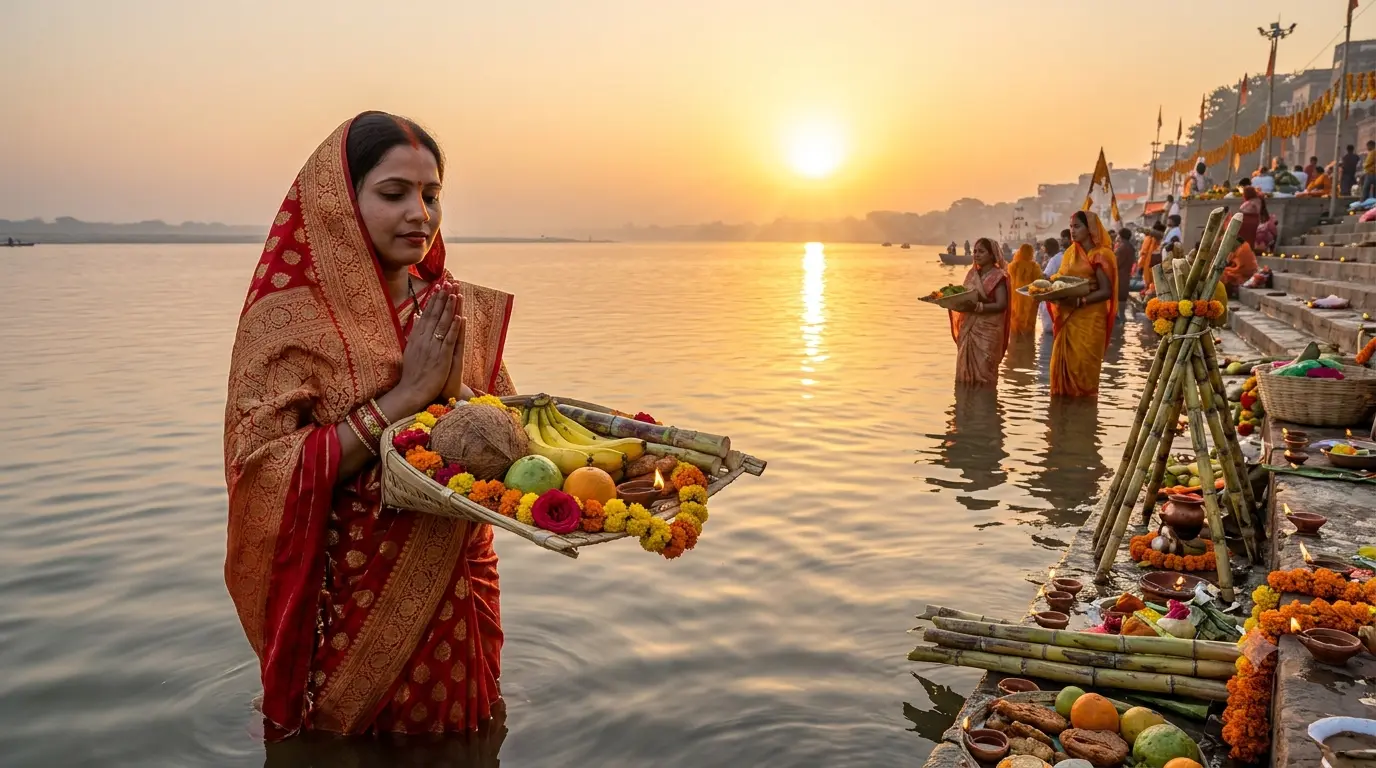
Devotees stand in the water and wait for the setting Sun. Around sunset, they offer Arghya to Lord Surya.
While offering Arghya, devotees pray to the Sun God for the happiness, prosperity, health and well-being of their families. They also remember Chhathi Maiya.
Folk songs are sung at the ghats and lamps are lit, filling the surroundings with devotion.
The scene during Chhath is particularly moving. As the light of the day slowly fades, devotees wait with complete faith for the sunrise of the following morning.
Day Four: Usha Arghya and Paran
The final day of Chhath Puja will fall on Monday, 16 November 2026.
On this day, devotees and their family members reach the ghat before sunrise. The presence of devotees and glowing lamps in the darkness creates a unique atmosphere.
When the first rays of the Sun appear in the morning, devotees stand in the water and offer Arghya to the rising Sun.
This ritual is known as Usha Arghya.
The tradition of offering Arghya to the setting Sun and then offering it again to the rising Sun the following morning makes Chhath Puja distinctive. It conveys the message that every stage of life has its own importance and that every new morning brings hope.
After Usha Arghya, devotees pray to Chhathi Maiya and Lord Surya for the well-being of their families. The fast is then completed through Paran, according to family and regional traditions.
Prasad is distributed among family members and others. People exchange greetings and wish one another a happy Chhath.
In this way, the four-day spiritual observance comes to an end.
Chhath Puja Prasad and Its Significance
Special attention is given to the purity and traditional preparation of Prasad during Chhath Puja. The offerings used in this festival carry religious and cultural significance beyond their role as food.
Thekua
Thekua is the most famous Prasad of Chhath Puja. It is prepared using wheat flour, jaggery or sugar and ghee.
Some families also add fennel seeds or other traditional ingredients. Its taste and preparation method may vary slightly from one region to another.
Thekua can remain fresh for a relatively long time, making it convenient to distribute as Prasad.
Jaggery Kheer
Jaggery kheer is specially prepared on the day of Kharna. In many parts of Bihar and eastern Uttar Pradesh, it is known as Rasiyaw.
It is prepared using rice, milk and jaggery. Many families follow the tradition of cooking it on an earthen stove.
Bananas and Other Fruits
Bananas, coconuts, apples and other seasonal fruits are placed in the Chhath baskets. The selection of fruits depends on local availability and family traditions.
Sugarcane and Coconut
Sugarcane is an important offering during Chhath Puja. It is also regarded as a symbol of nature’s produce and agricultural prosperity.
Coconut is considered auspicious and is used in many Hindu forms of worship.
Significance of Bamboo Baskets and Winnowing Trays in Chhath Puja
Bamboo baskets and winnowing trays have a special place in Chhath Puja. They are used to arrange the Prasad and other worship materials before carrying them to the ghat.
Bamboo has traditionally been an important part of rural Indian life. It is used to make baskets, winnowing trays and many other household items.
The use of bamboo items during Chhath Puja is connected with regional traditions. It also reflects the simplicity of the festival’s folk culture and rural life.
Several family members help arrange the offerings in the baskets. Women, in particular, play an important role in these preparations.
Traditional Folk Songs of Chhath Puja
Folk songs have a special place in Chhath celebrations. In the villages of Bihar and eastern Uttar Pradesh, Chhath songs can be heard several days before the festival begins.
These songs express the glory of Chhathi Maiya, the worship of Lord Surya, prayers for family well-being and the emotions of devotees observing the fast.
Some songs also explore themes such as a daughter’s departure after marriage, the affection of parents and the happiness of family life.
Chhath folk songs are not merely a form of entertainment. They preserve cultural memories that have been passed down from one generation to another.
When devotees sing songs in praise of Chhathi Maiya together at the ghats, the entire atmosphere becomes filled with devotion and emotion.
Chhath Puja in India and Abroad
Chhath Puja has its deepest cultural roots in Bihar, Jharkhand, eastern Uttar Pradesh and the Terai region of Nepal.
As people from these regions moved to other parts of the country for employment, education and business, they carried the tradition of Chhath with them.
Today, Chhath Puja is celebrated on a large scale in Delhi and the National Capital Region. Devotees offer Arghya at the Yamuna riverbank and at various designated ghats.
Collective celebrations are also organised in Mumbai, Pune, Kolkata, Lucknow, Kanpur, Bhopal and many other cities.
Chhath is especially popular in the Terai region of Nepal. In places such as Janakpur, the festival is celebrated with traditional enthusiasm.
Chhath Puja has also spread to Indian-origin communities living abroad. People in countries such as Mauritius, Fiji, Suriname, Guyana and Trinidad and Tobago have preserved many of their religious and cultural traditions.
Indian families living in the United Kingdom, the United States, Canada, Australia and Gulf countries also organise Chhath celebrations.
Devotees living abroad perform the rituals at beaches, rivers, lakes or designated community locations, subject to local rules and the necessary permissions.
In this way, Chhath is no longer limited to a single state or region. It has become an important symbol of Indian culture and the faith of Indian communities across the world.
Chhath Puja and Environmental Protection
Chhath Puja has a deep connection with nature. The Sun, water, fruits, grains and vegetation are all important elements of this festival.
For this reason, environmental protection should also be given attention while organising Chhath Puja.
Plastic bags, packaging and other rubbish should not be thrown into rivers or ponds. Keeping the ghats clean after the worship is a shared responsibility of all devotees.
Wherever possible, natural and reusable worship materials should be used.
Materials that may pollute the water or harm aquatic life should not be left in water bodies.
The true spirit of Chhath lies in respecting nature. Therefore, protecting water and the environment is also our responsibility, along with maintaining the purity of the festival.
Life Lessons from Chhath Puja
Every ritual of Chhath Puja points towards an important aspect of life.
Nahay Khay teaches us the importance of cleanliness and new beginnings. Kharna conveys the message of self-restraint and patience. Sandhya Arghya reminds us to respect every stage of life, including its later stages and difficult circumstances.
Usha Arghya symbolises hope, renewed energy and positive thinking.
This festival brings family members together. It strengthens the spirit of cooperation in society and provides an opportunity to express gratitude towards nature.
The message of Chhath Puja has become even more important in today’s busy world. Along with our achievements and comforts, we should also respect the natural resources that sustain our lives.
Conclusion
Chhath Puja is a unique tradition of Indian culture in which the worship of Lord Surya, devotion towards Chhathi Maiya and gratitude towards nature come together.
This four-day festival is a beautiful example of purity, discipline, self-restraint and collective cooperation. Devotees offer Arghya to the setting Sun and then wait for the rising Sun the following morning. This tradition inspires us to accept the ups and downs of life and welcome every new morning with hope.
In 2026, Chhath Mahaparv will be observed from 13 November to 16 November. The festival’s main evening offering, Sandhya Arghya, will take place on 15 November, followed by Usha Arghya and Paran on 16 November.
May Chhathi Maiya and Lord Surya bless every family with happiness, peace, good health and prosperity.
Jai Chhathi Maiya. Jai Surya Dev.
Frequently Asked Questions About Chhath Puja 2026
1. When is Chhath Puja in 2026?
In 2026, Chhath Puja will be observed from Friday, 13 November to Monday, 16 November. The main Chhath Puja rituals and Sandhya Arghya will take place on Sunday, 15 November.
2. When is Nahay Khay during Chhath Puja 2026?
The first day of Chhath Puja, Nahay Khay, will be observed on Friday, 13 November 2026.
3. When will Kharna be observed during Chhath Puja?
In 2026, Kharna will be observed on Saturday, 14 November. After the evening worship and consumption of Prasad, devotees observing the traditional Nirjala fast begin their fast without food or water.
4. When will Sandhya Arghya be offered during Chhath Puja?
Sandhya Arghya will be offered around sunset on Sunday, 15 November 2026.
5. When will Usha Arghya be offered during Chhath Puja?
Usha Arghya will be offered around sunrise on Monday, 16 November 2026. The fast is completed through Paran afterwards.
6. How many days does Chhath Puja last?
Chhath Puja is observed over four days. Its four main stages are Nahay Khay, Kharna, Sandhya Arghya and Usha Arghya.
7. Which deities are worshipped during Chhath Puja?
Lord Surya and Goddess Shashthi are primarily worshipped during Chhath Puja. In folk traditions, Goddess Shashthi is widely known as Chhathi Maiya.
8. Who is Chhathi Maiya?
Chhathi Maiya is regarded in popular tradition as a form of Goddess Shashthi. She is worshipped as the Goddess who protects children and blesses families with the well-being of their offspring.
9. Can men also observe the Chhath Puja fast?
Yes, men can also observe Chhath Vrat with devotion and discipline. Both men and women participate in the festival and its rituals.
10. When does the approximately 36-hour waterless fast begin during Chhath Puja?
According to the traditional observance, the Nirjala fast begins after devotees consume Prasad on the evening of Kharna. It continues until Usha Arghya is offered and Paran is performed the following morning.
11. Which offerings are presented during Chhath Puja?
The offerings during Chhath Puja include Thekua, jaggery kheer, bananas, coconuts, sugarcane, apples and other seasonal fruits. The offerings may vary according to regional and family traditions.
12. Why is Chhath Puja also known as Surya Shashthi?
The main observance of this festival takes place on Kartik Shukla Shashthi and is dedicated to the worship of Lord Surya. For this reason, it is also known as Surya Shashthi.
13. Why is Arghya offered to the setting Sun during Chhath Puja?
Offering Arghya to the setting Sun during Chhath is regarded as a symbol of respect and gratitude towards every stage of life. The following morning, Arghya is offered to the rising Sun to welcome a new beginning.
14. In which states is Chhath Puja mainly celebrated?
Chhath Puja is especially popular in Bihar, Jharkhand and eastern Uttar Pradesh, as well as in the Terai region of Nepal. It is now also celebrated in many other parts of India and abroad.
15. Can Chhath Puja be performed at home?
Where a river or public ghat is not available, families may offer Arghya at a safe place with clean water, according to their family traditions and local arrangements. Cleanliness and devotion should be given special attention during the worship.