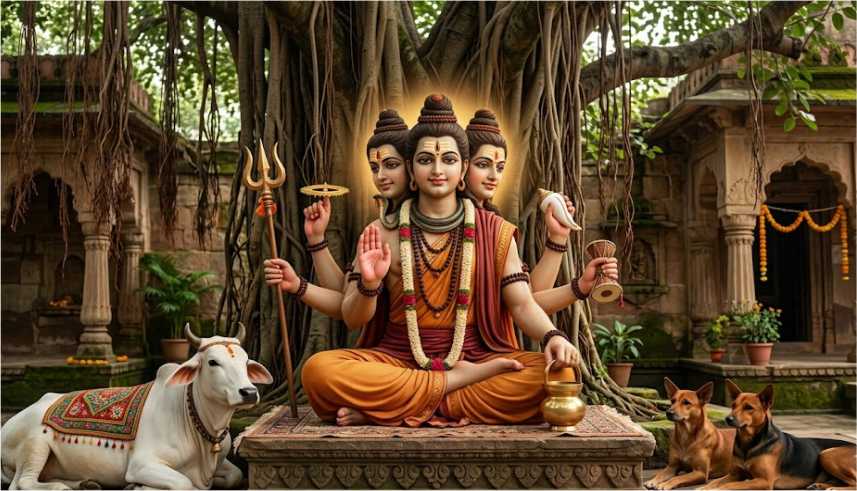
Lord Dattatreya is regarded as one of the most extraordinary and mysterious deities in Hinduism, embodying the combined divine powers of Brahma, Vishnu, and Mahesh (Shiva). In the Sanatan tradition, He is worshipped not only as a deity but also as the Adi Guru, a great yogi, and a spiritual guide. According to the devotional philosophy of Bhakti Margdarshan, Lord Dattatreya represents renunciation, wisdom, spiritual discipline, and self-realization. His teachings inspire individuals to rise above worldly attachments and understand the true nature of the soul and the Supreme Reality.
Hinduism is considered one of the oldest spiritual traditions in human civilization. Various studies and historical discussions have explored evidence suggesting that Vedic literature and Sanatan traditions originated thousands of years before the Common Era. References to Lord Dattatreya are also found in ancient Hindu traditions. He is regarded as an incarnation of the Trimurti, representing the three fundamental cosmic powers of creation, preservation, and destruction.
Shri Dattatreya Swami is revered as a great ascetic and wandering yogi. He showed the path of detachment, self-knowledge, and liberation. Sacred texts such as the Shri Guru Charitra, Avadhuta Gita, and Jivanmukta Gita contain extensive descriptions of his teachings and philosophy. These scriptures give special importance to Advaita (non-dualism), self-realization, and the experience of the Supreme Truth.
Lord Dattatreya is not limited to any single religious sect. Numerous spiritual traditions and schools of practice across India recognize Him as the Adi Guru. He is regarded as a divine teacher who brings different spiritual paths and philosophies together. Let us explore the mysterious life, divine origin, and spiritual glory of Lord Dattatreya in detail.
Mythological Beliefs and the Origin of Lord Dattatreya
According to traditional beliefs, Shri Gurudev Datt manifested thousands of years ago during the Satya Yuga. The origin of Dattatreya Swami is traditionally placed even before the incarnations of Lord Shri Rama and Lord Shri Krishna. Scriptures such as the Bhagavata Purana, Markandeya Purana, and Brahmanda Purana describe Him as an incarnation of the Supreme Brahman and the combined divine form of the Trimurti.
The story of Lord Dattatreya begins with Sage Atri and his devoted wife, Mata Anasuya. Sage Atri was one of the Saptarishis (Seven Great Sages), while Mata Anasuya was renowned for her spiritual austerities, purity, and devotion.
The word “Datta” means “given” or “bestowed,” while “Atreya” means “the son of Atri.” Thus, His name reflects His divine birth and lineage. According to the Suta Samhita, the Dattatreya incarnation manifested during the Satya Yuga on the tenth day of the dark fortnight of the Vaishakha month, which fell on a Thursday under the Revati Nakshatra.
Shri Gurudev Datta and Bhakti Margdarshan
According to a popular legend, Sage Atri and Mata Anasuya wished to have a child. To fulfill this desire, Sage Atri performed intense penance and received the blessings of Brahma, Vishnu, and Mahesh. Pleased with his devotion and austerities, the Trimurti blessed him with a divine son who embodied the combined powers of all three deities. This divine child later became known as Lord Dattatreya.
Another famous legend describes how Goddess Saraswati, Goddess Lakshmi, and Goddess Parvati became curious about the extraordinary purity and devotion of Mata Anasuya. The three goddesses decided to test her chastity and spiritual strength through the Trimurti.
Brahma, Vishnu, and Mahesh arrived at Mata Anasuya’s hermitage disguised as sages and asked for alms. They placed a condition that she must serve them food while unclothed. Using the power of her spiritual austerities, Mata Anasuya transformed them into infants and lovingly fed them with maternal affection. Pleased with her devotion and purity, the three divine beings manifested as a single child, who came to be known as Dattatreya.
According to a third account, Mata Anasuya gave birth to Dattatreya, Durvasa, and Chandra (the Moon God). Another traditional belief associates the birthplace of Lord Dattatreya with Mahur in Maharashtra. Some other traditions hold that He manifested in the forests of Kashmir, near Amarnath.
Divine Appearance and Sacred Form of Lord Dattatreya
Lord Dattatreya is traditionally depicted with three heads and six arms. His three faces symbolize Brahma, Vishnu, and Mahesh, representing the combined powers of the Trimurti. Each of His six hands holds a different divine object.
His hands holding a rosary and a Kamandalu (water pot) are associated with Lord Brahma. The conch and discus represent the divine powers of Lord Vishnu, while the trident and Damaru (small drum) symbolize Lord Shiva.
Lord Gurudev Dattatreya is also traditionally depicted with four dogs and a cow accompanying Him. The four dogs are considered symbols of the four Vedas, while the cow represents Mother Earth and Dharma (righteousness). Thus, Lord Dattatreya embodies a wonderful combination of wisdom, divine power, and compassion.
According to traditional beliefs, He embodies all three Gunas (qualities of nature): Sattva, Rajas, and Tamas. Therefore, He is also known as “Trigunatmaka Datta.” A true Guru is one who helps a seeker experience the formless Brahman, and Shri Dattatreya is revered as the Guru of all Gurus. For this reason, He is worshipped as the Adi Guru of the entire universe.
Who Is Lord Dattatreya and What Is His Spiritual Significance?
Hindu scriptures describe Lord Dattatreya not merely as a deity but also as a great spiritual teacher and philosopher. His philosophy of Advaita (non-dualism) is described in sacred texts such as the Avadhuta Gita and Jivanmukta Gita. His teachings guide seekers toward self-realization by helping them become free from worldly attachments.
It is traditionally believed that Dattatreya renounced worldly life at a young age and adopted the path of spiritual austerity. He is widely recognized as a wandering yogi and ascetic. His life represents renunciation, wisdom, and spiritual freedom.
Numerous spiritual traditions across India worship Lord Dattatreya. He is revered as a giver of spiritual accomplishments, a Sadguru (true spiritual master), and a guide on the path of Ashtanga Yoga (Eightfold Yoga). The Dattatreya incarnation is also regarded as a symbol of the creation, preservation, and dissolution of the universe.
Worship of Gurudev Dattatreya
Lord Dattatreya is especially worshipped in several Indian states, including Maharashtra, Gujarat, Karnataka, Andhra Pradesh, and Telangana. In the Nath tradition, He is revered as Adinath and the First Guru. He also holds special significance in both Shaiva and Vaishnava traditions.
The Mahabharata and various Puranas describe Lord Dattatreya as an incarnation of Lord Vishnu and a great spiritual teacher. According to certain traditional beliefs, He renounced worldly life at a young age and adopted the path of Sannyasa (renunciation). The Tripura Rahasya also contains an account of a disciple of Parashurama encountering Lord Dattatreya in a meditative state.
Lord Dattatreya is also respected in Jain traditions. According to a traditional belief, He left His sacred footprints on Mount Girnar during His travels.
The Nath Sampradaya and Mahanubhava tradition also hold Lord Dattatreya in great reverence. The Marathi scripture Navnath Bhaktisar portrays Him as a Guru while describing the combined worship of Vishnu and Shiva. Thus, devotees of Lord Dattatreya belong to various spiritual communities and Guru traditions.
During the worship of Lord Dattatreya, devotees chant special Mantras and seek His blessings for wisdom, good health, and spiritual progress. Worship generally includes flowers, incense, sacred offerings, and the recitation of religious scriptures. Reading the Avadhuta Gita and Shri Guru Charitra is considered especially auspicious. Thursday is regarded as the most sacred day for worshipping Lord Dattatreya.
Festivals and Pilgrimage Sites Associated with Lord Dattatreya
The most important festival associated with Lord Dattatreya is Datta Jayanti. It is celebrated on the full moon day of the Margashirsha month, which generally falls in December.
On Datta Jayanti, devotees gather in temples to perform special prayers and Abhishekam (ritual bathing of the deity). The idol of Lord Dattatreya is decorated with new clothes and ornaments. Devotees sing Dattatreya Aartis, devotional songs, and hymns dedicated to Guru Bhakti. Recitation of the Shri Dattatreya Stotra and Upanishads is also performed.
Lord Dattatreya is also worshipped with special devotion on the occasion of Guru Purnima.
Several important pilgrimage sites associated with Lord Dattatreya are located across India. Among the most famous are Shri Kshetra Ganagapur in Karnataka, Mount Girnar in Gujarat, Pithapuram in Andhra Pradesh, and Mahur Temple in Maharashtra. Thousands of devotees visit these sacred places to seek His blessings, especially during religious festivals.
Also Read: Different Incarnations of Lord Dattatreya
Incarnations of Lord Dattatreya
Lord Dattatreya is regarded as the combined incarnation of the Trimurti, and sixteen major forms of His divine manifestation are traditionally described. These forms are collectively known as the “Shodasha Avatars” (Sixteen Incarnations).
Yogiraj represents the Lord as the master of yoga and spiritual practice. Atrivarada is the divine form that blesses devotees and fulfills their sincere wishes. Dattatreya represents His original form, embodying the combined powers of the Trimurti. Kalagni Shamana represents the form that calms the destructive fire of time and dissolution.
Krishnashyam Kamalanayana represents His beautiful and compassionate appearance. Leelavishambhar symbolizes His divine cosmic pastimes. Siddhatraya represents the Guru who has attained complete spiritual perfection. Vishwambharavatara represents the divine protector and sustainer of the universe.
Avadhuta Chintopasaka represents His ascetic form, which remains beyond worldly attachments. Mayamuktananda symbolizes the bliss of freedom from Maya (illusion). Mayamukta represents the divine form that guides devotees beyond ignorance and illusion. Adiguru is worshipped as the First Spiritual Teacher.
In addition to these forms, manifestations such as Shripad Shrivallabha, Narasimha Saraswati, Swami Samarth, and Manik Prabhu are also held in great reverence.
All these manifestations reveal different aspects of Lord Dattatreya’s wisdom, austerity, compassion, and spiritual power.
Through these sixteen manifestations, Lord Dattatreya guides His devotees toward spiritual discipline, self-realization, inner wisdom, and liberation (Moksha).
Special Highlight
Lord Dattatreya (Lord Dattatreya) is regarded in Hinduism as the combined incarnation of Brahma, Vishnu, and Mahesh. He symbolizes the Adi Guru, spiritual wisdom, and yogic knowledge. Devotees worship Him to attain self-realization, renunciation, spiritual enlightenment, and liberation from the cycle of worldly existence.
Frequently Asked Questions
Who is Lord Dattatreya?
Lord Dattatreya is regarded as the combined incarnation of the three supreme Hindu deities: Brahma, Vishnu, and Mahesh. He is worshipped as the Adi Guru, a great yogi, and a divine spiritual teacher.
How was Lord Dattatreya born?
According to Hindu mythology, Lord Dattatreya was born to Sage Atri and Mata Anasuya as the result of their devotion, spiritual austerities, and divine blessings.
When is Datta Jayanti celebrated?
Datta Jayanti is celebrated on the full moon day of the Margashirsha month, which generally falls in December.
What are the major pilgrimage sites associated with Lord Dattatreya?
The major pilgrimage sites associated with Lord Dattatreya include Ganagapur, Mount Girnar, Mahur, and Pithapuram. These sacred places are visited by devotees seeking His blessings and spiritual guidance.