Introduction to Ram Vanvas Katha
Ram Vanvas Katha (The Story of Lord Rama’s Exile) is one of the most emotional and significant stories in Hinduism. It describes an important phase in the life of Lord Shri Rama, when he had to leave his kingdom of Ayodhya and spend 14 years in exile in the forest.
This event was not merely a royal decision but a remarkable example of righteousness, duty, sacrifice, and moral values.
Lord Shri Rama is known as Maryada Purushottam because he always followed the path of truth and righteousness, even when circumstances were extremely difficult.
The Atmosphere in Ayodhya
At that time, Ayodhya was a prosperous and peaceful kingdom. King Dasharatha had four sons — Shri Rama, Lakshmana, Bharata, and Shatrughna.
Shri Rama was the eldest and most beloved son of the king. He was deeply respected and loved by everyone in Ayodhya.
The people believed that Shri Rama would become the future king and that peace and happiness would continue throughout the kingdom.
Kaikeyi’s Boons
King Dasharatha had three queens — Kaushalya, Kaikeyi, and Sumitra.
Once, Kaikeyi had saved King Dasharatha’s life during a difficult situation. At that time, the king had promised to grant her two boons whenever she wished.
After some time, influenced by her maid Manthara, Kaikeyi decided to ask for those two boons:
- Bharata should be crowned as the king of Ayodhya.
- Shri Rama should be sent into exile for 14 years.
King Dasharatha’s Sorrow
When King Dasharatha heard Kaikeyi’s demands, he was deeply heartbroken. He loved Shri Rama more than anything.
However, because of his promise, he felt helpless and could not refuse her demands.
His heart was filled with immense sorrow.
It was an extremely emotional moment because a father was being forced to separate from his beloved son.
Shri Rama’s Decision
When Shri Rama learned about the order of exile, he accepted it without any protest.
He believed that fulfilling his father’s promise was one of the greatest duties of a son.
His character demonstrated extraordinary greatness because he willingly gave up the royal throne and all worldly comforts to fulfill his father’s word.
Mother Sita and Lakshmana Accompany Shri Rama
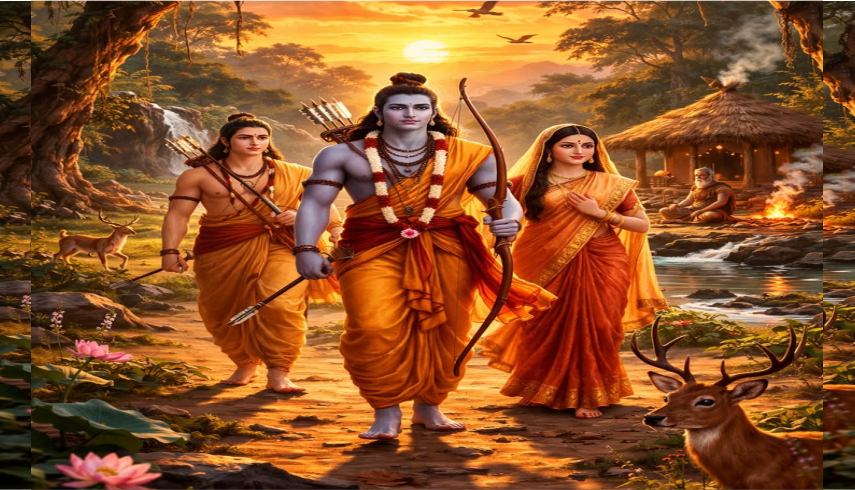
Mother Sita decided to accompany Shri Rama into the forest. She expressed that she would remain with her husband in every situation, whether it brought happiness or hardship.
Lakshmana also decided to accompany his elder brother Shri Rama into exile.
Thus, all three decided to leave Ayodhya together.
The Emotional Departure from Ayodhya
When Lord Shri Rama, Mother Sita, and Lakshmana prepared to leave Ayodhya for their 14 years of exile, the entire kingdom became overwhelmed with sorrow.
Silence spread through the streets of Ayodhya, and people began to cry. Nobody could believe that their beloved Shri Rama was leaving the kingdom.
King Dasharatha was the most distressed of all. He could not bear the pain of being separated from his beloved son.
This was not merely the separation of a family but a heartbreaking moment for the entire kingdom.
Crossing the River Ganga with Kevat
During their journey into exile, Shri Rama, Sita, and Lakshmana reached the banks of the River Ganga.
There, they requested a boatman named Kevat to help them cross the river.
Initially, Kevat hesitated to take them across. However, when he recognized the divinity of Shri Rama, he respectfully agreed and helped them cross the river.
This episode teaches us that devotion and faith can make even the most difficult tasks easier.
Beginning of Forest Life
After crossing the River Ganga, the three entered the forest.
Their life in the forest was completely different from their comfortable life in Ayodhya.
There were no palaces or luxurious facilities, only the simplicity of nature.
Shri Rama adopted a simple lifestyle. He began spending time in the forests and visiting the hermitages of sages while continuing to follow the path of righteousness.
Meeting the Sages
During their exile, Shri Rama met several sages and saints.
He gained knowledge about righteousness, meditation, spiritual practices, and the deeper meaning of life.
The sages welcomed Shri Rama and blessed him, expressing their hope that he would destroy evil and establish righteousness.
Journey Towards Panchavati
As time passed, Shri Rama, Sita, and Lakshmana travelled towards Panchavati.
Panchavati was an extremely beautiful and peaceful place where they decided to stay for some time.
Later, this place became the center of several important events in the Ramayana.
Spiritual Meaning of Ram Vanvas
Ram Vanvas was not merely a physical journey but also carries a deep spiritual message.
- Shri Rama: Symbolizes righteousness and truth.
- The Forest: Represents the difficulties and challenges of life.
- Sacrifice: Represents the test of one’s character and inner strength.
This story teaches us that happiness and sorrow are both parts of life, but we should never abandon the path of righteousness.
Life in Panchavati
In Panchavati, the lives of Lord Shri Rama, Mother Sita, and Lakshmana had become simple and peaceful.
The surroundings were filled with dense forests, the sounds of birds, and the beauty of nature.
Shri Rama spent time with sages, discussed matters of righteousness, and followed the principles of forest life.
Mother Sita also lived a simple life, while Lakshmana remained constantly devoted to protecting them.
However, an important incident was about to take place in this peaceful forest, an event that would change the course of the entire Ramayana.
The Arrival of the Golden Deer
One day, an extraordinarily beautiful golden deer appeared in the forest of Panchavati.
Its body shone like gold, making it extremely attractive and fascinating.
When Mother Sita saw the deer, she was captivated by its beauty. She requested Lord Shri Rama to capture it and bring it to her.
This was the moment from which the plan of evil began to unfold.
Shri Rama Chases the Deer
To fulfill Mother Sita’s wish, Shri Rama went after the golden deer.
Before leaving, he instructed Lakshmana to protect Mother Sita carefully and not to leave her alone under any circumstances.
This was the beginning of an important turning point in the story.
Maricha’s Deceptive Plan
In reality, the golden deer was the demon Maricha, who had been sent by Ravana as part of his plan.
To take Shri Rama far away from the hermitage, Maricha used deception and led him deep into the forest.
After some time, Maricha called out in Shri Rama’s voice, shouting, “Lakshmana! Lakshmana!”
Lakshmana’s Doubt and Departure
When Lakshmana heard the voice, he became worried.
However, he did not consider it appropriate to leave Mother Sita alone.
Mother Sita urged Lakshmana to go and help Shri Rama, but Lakshmana initially refused.
However, after repeated requests from Mother Sita, Lakshmana finally decided to leave.
Before departing, he drew a protective line around the hermitage, which later became famous as the Lakshmana Rekha.
Importance of Lakshmana Rekha
The Lakshmana Rekha was considered a divine protective boundary within which Mother Sita remained safe.
Lakshmana warned her that nobody would be able to harm her as long as she remained within that boundary.
However, Ravana planned to exploit this very protection to carry out his evil intentions.
Ravana’s Deception
Ravana arrived at the hermitage disguised as a sage.
He politely approached Mother Sita and asked her for alms.
Following the principles of kindness and hospitality, Mother Sita stepped outside the Lakshmana Rekha to offer him alms.
At that very moment, Ravana revealed his true identity.
The Beginning of Sita’s Abduction
Ravana forcibly abducted Mother Sita and took her towards Lanka in his Pushpaka Vimana.
Mother Sita continuously called out the name of Lord Shri Rama and resisted Ravana, but he succeeded in carrying her away.
Jatayu’s Brave Fight
As Ravana was carrying Mother Sita away in his Pushpaka Vimana, a mighty bird king named Jatayu appeared.
When Jatayu witnessed the incident, he immediately understood that an act of injustice was taking place.
He tried to stop Ravana from abducting Mother Sita.
A fierce battle took place between Jatayu and Ravana. Jatayu used all his strength to protect Mother Sita, but Ravana was extremely powerful.
Eventually, Ravana severely wounded Jatayu.
Jatayu’s Sacrifice
After being severely injured, Jatayu fell to the ground.
Even in his final moments, he did not abandon the path of righteousness.
Although he could not save Mother Sita, his sacrifice became a great example in the Ramayana, teaching us that giving one’s life in the service of righteousness is also a noble act.
Shri Rama’s Sorrow and Discovery of the Truth
When Shri Rama and Lakshmana returned, they discovered that Mother Sita was missing.
Seeing this, Shri Rama became extremely distressed. His heart was filled with sorrow, but he did not lose his courage.
A little later, they found the injured Jatayu, who told them everything about the incident and informed them that Ravana had taken Mother Sita towards the southern direction.
The Journey to Search for Sita
After this incident, Shri Rama began searching for Mother Sita with the help of the Vanara army.
They searched many places and gradually continued their journey towards the southern direction.
This journey was not merely a physical search but also represented the search for righteousness and the struggle against evil.
The Arrival of Lord Hanuman
During this journey, Lord Hanuman, the greatest devotee of Shri Rama, became an important part of the story.
With his devotion and extraordinary strength, Hanuman crossed the ocean and entered Lanka.
He reached Ashoka Vatika in search of Mother Sita and finally met her there.
Mother Sita and Shri Rama’s Message
Hanuman conveyed Shri Rama’s message to Mother Sita and assured her that Shri Rama would soon free her from Ravana’s captivity.
Mother Sita blessed Hanuman and sent a message for Shri Rama, expressing her faith that righteousness would ultimately triumph.
Conclusion of Ram Vanvas Katha
Ram Vanvas Katha teaches us several important lessons:
- We should never abandon righteousness, even during the most difficult times of life.
- Sacrifice and patience are among the greatest strengths of a person.
- Devotion and faith help us overcome even the greatest challenges.
- Evil and unrighteousness are ultimately destined to come to an end.
The exile of Shri Rama was not merely a punishment but a divine plan that eventually paved the way for the destruction of Ravana and the establishment of righteousness.
Frequently Asked Questions (FAQs)
1. Why did Lord Rama go into exile?
Lord Rama was sent into exile for 14 years because of the two boons demanded by Queen Kaikeyi from King Dasharatha.
2. Who accompanied Lord Rama during his exile?
Mother Sita and Lakshmana accompanied Lord Rama during his 14 years of exile in the forest.
3. What is the main message of Ram Vanvas?
The main message of Ram Vanvas is that we should always follow truth, righteousness, duty, and the path of sacrifice, regardless of the difficulties we face.
4. What was the most important incident during Lord Rama’s exile?
The abduction of Mother Sita by Ravana was one of the most significant turning points during Lord Rama’s exile. It eventually led to the battle between Lord Rama and Ravana.