Lord Shiva is regarded as one of the supreme deities of Sanatan Dharma. His presence is deeply connected with devotion, yoga, meditation and spirituality. According to the spiritual philosophy of Bhakti Margdarshan, Lord Shiva is not merely a deity but represents the eternal truth that maintains the balance between life, death, creation and destruction. He is known as Adiyogi because he is believed to be the first yogi who shared the knowledge of yoga and showed the path towards spiritual liberation.
Many Hindu scriptures describe Lord Shiva as a deity absorbed in deep meditation and samadhi. His life and divine form convey the message that spiritual wisdom and liberation can be attained even while living in the material world. The form of Lord Shiva is mysterious, yet his philosophy offers profound lessons about life, consciousness and self-realisation.
The Divine Form and Origin of Lord Shiva
The Sanskrit word “Shiva” means “the auspicious one” or “the benevolent one.” Lord Shiva is considered Anadi and Anant, meaning that he has neither a beginning nor an end. In Sanatan Dharma, he is understood as the supreme truth that exists throughout the universe. His divine existence is not limited to a single physical form but represents the eternal consciousness that pervades all creation.
In Hindu tradition, Lord Shiva is an important part of the Trimurti. Lord Brahma is associated with creation, Lord Vishnu with preservation, and Lord Mahesh (Shiva) with destruction. However, his role is not limited to destruction. He removes negative forces and brings an end to the old so that a new beginning can take place.
In several religious traditions, Lord Shiva is worshipped as the supreme power from whom the entire universe originates. He is also associated with the sacred sound “Om,” which is regarded as a symbol of the origin of creation and cosmic energy. The Shiva Lingam represents the divine and creative power of Lord Shiva and holds great importance in Hindu worship.
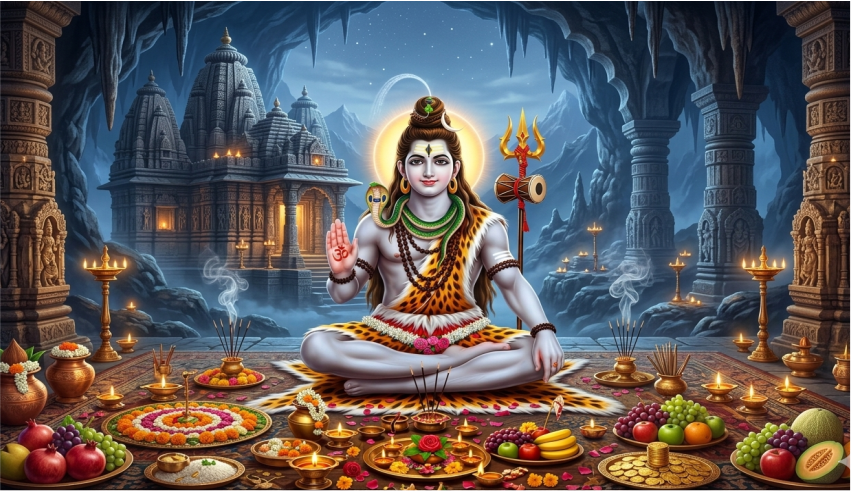
Religious scriptures and traditional depictions show Lord Shiva performing intense meditation in the Himalayan region. His appearance is unique and full of symbolic meaning. Sacred ash covers his body, a serpent rests around his neck, and he carries a Trishul (trident) and a Damaru (small drum). The crescent moon adorns his matted hair, while the third eye on his forehead is one of his most distinctive features. Rudraksha beads and his simple appearance represent detachment from material pleasures.
The third eye of Lord Shiva is considered a symbol of wisdom, knowledge and higher consciousness. According to traditional belief, when this eye opens, ignorance is destroyed and the light of truth becomes visible. In yogic philosophy, it is also associated with spiritual awakening and inner awareness. For this reason, Lord Shiva is often described as Sarvagya, meaning the all-knowing one.
Although Lord Shiva exists within the universe, he remains free from worldly attachments. His life teaches that a person can fulfil worldly responsibilities while maintaining inner peace, self-control and spiritual freedom. Mount Kailash, located in the Himalayan region, is traditionally regarded as his divine abode.
The Shiva Purana, Vayu Purana, Rigveda and other Hindu scriptures contain references to Lord Shiva and his divine consort, Shakti. His family includes Goddess Parvati, his sons Kartikeya and Ganesha, his daughter Ashokasundari, along with Nandi and his divine attendants, known as Ganas.
Shiva and Shakti – The Highest Expression of Divine Love
Lord Shiva and Goddess Shakti are regarded as the fundamental forces of creation. Shiva represents pure consciousness, while Shakti represents energy and the power of nature. Together, they symbolise the harmony through which the universe functions. In Hindu philosophy, they are considered inseparable and complementary aspects of the same divine reality.
According to traditional religious narratives, the relationship between Shiva and Shakti represents divine love, devotion and spiritual unity. In some traditional accounts, Shiva and Shakti originally existed as one divine reality. Their separation is symbolically connected with the manifestation of creation and the diversity of the universe.
Goddess Shakti manifested in human form as Goddess Sati, the daughter of Daksha and Prasuti. Daksha was known for his devotion to Lord Vishnu and his opposition to Lord Shiva. Sati, however, was deeply devoted to Shiva and eventually married him despite her father’s disapproval.
Their marriage became an important episode in Hindu mythology. During a grand yajna organised by Daksha, Lord Shiva was insulted and was not given the respect due to him. Unable to bear the humiliation of her husband, Goddess Sati gave up her physical body in the sacrificial fire. This event is remembered as one of the most sorrowful episodes in the divine life of Lord Shiva.
After this incident, Goddess Shakti took birth again as Goddess Parvati, the daughter of Himavan and Maina. In this birth, she was destined to reunite with Lord Shiva. Through deep devotion, discipline and intense penance, she sought to attain him as her divine consort.
The reunion of Lord Shiva and Goddess Parvati is not merely a story of love. It also represents spiritual discipline, devotion, inner awakening and the harmony between consciousness and energy. Their divine relationship conveys important lessons about balance, dedication and the spiritual journey of life.
Avatars and Divine Names of Lord Shiva
Hindu scriptures describe numerous divine manifestations and incarnations of Lord Shiva. The number of his avatars differs across various Puranic traditions. Some religious texts mention 19 manifestations, while others describe 28 forms.
The 108 names of Lord Shiva are found in various Shiva Stotras and devotional texts. His different manifestations include the 11 Rudras, the 12 Jyotirlingas, the Ashtamurti forms and other divine expressions.
The word “Shankara” means the one who brings welfare and auspiciousness. Lord Shiva is also known as Bholenath because he is traditionally believed to be easily pleased by the sincere devotion of his devotees. He is considered compassionate and readily responds to prayers offered with a pure heart.
Lord Hanuman is traditionally regarded as the 11th Rudra manifestation of Lord Shiva. This divine manifestation is associated with the service and devotion of Lord Hanuman towards Lord Shri Rama. Hanuman Ji is also counted among the seven Chiranjivis, who are believed to be immortal.
Lord Shiva is also associated with the sacred syllable “Om” and is sometimes referred to as Pranava. As the divine source of music, dance and artistic expression, he is worshipped as Nataraja. His cosmic dance, known as Tandava, symbolises the continuous cycle of creation, preservation and dissolution.
Lord Shiva is worshipped by many other names, including Mahadev, Parmeshwar, Sarveshwar and Sanatan. According to the Shiva Purana, he is unborn, eternal and infinite.
Since Mount Kailash is regarded as his divine abode, he is known as Kailashpati. As the lord of spirits, divine attendants and all living beings, he is also called Bhootnath and Pashupati. Because he possesses three eyes, he is known as Trilochan.
Devotion and Worship of Lord Shiva
Lord Shiva is one of the most widely worshipped deities in Hinduism. His worship has many forms, reflecting the depth and diversity of his divine nature. Followers who regard Lord Shiva as the supreme reality and worship him are traditionally known as Shaivas.
Shaivism has several philosophical and spiritual traditions, including Shaiva Siddhanta, Kashmir Shaivism and different paths of yoga and meditation. The history of Shiva worship is associated with ancient Vedic traditions and archaeological interpretations of the Indus Valley Civilisation, including the famous Pashupati seal.
Even today, Lord Shiva is worshipped in many different ways. Some devotees offer prayers to the Shiva Lingam, while others worship his divine image in a meditative posture.
Common offerings during Shiva worship include water, milk, Bilva leaves and flowers. Mondays and the holy month of Shravan are considered especially auspicious for worshipping Lord Shiva. During Mahashivratri, devotees visit Shiva temples, observe fasting and participate in devotional singing and prayers.
Several sacred hymns and prayers are dedicated to Lord Shiva, including the Shiva Tandava Stotram, Mahamrityunjaya Mantra, Shiva Stuti and Shiv Ashtak. These devotional compositions are widely recited by devotees seeking peace, spiritual strength and divine blessings.
Devotees also visit sacred pilgrimage destinations associated with Lord Shiva, including Kedarnath, Badrinath, Amarnath and Kashi. These places hold great importance in Hindu religious tradition. According to the spiritual teachings of Bhakti Margdarshan, meditation and yoga are also important paths through which devotees can deepen their connection with Lord Shiva.
Lord Shiva is also regarded as the divine patron of dance and music. Many devotees express their devotion through singing, devotional music, dance and other forms of artistic worship. It is traditionally believed that sincere devotion to Lord Shiva helps a person progress towards spiritual awakening and liberation.
One of the most cherished qualities associated with Lord Shiva is his impartial love for all devotees. He does not distinguish between people based on wealth, status or social position. He is believed to be pleased by simple, sincere and selfless devotion. This is why devotees lovingly call him Bholenath or Bhole Baba.
Lord Shiva as a Philosophy of Life
The significance of Lord Shiva extends beyond religious worship. His divine form also represents a profound philosophy of life. He symbolises both creation and destruction and teaches that change is an essential truth of existence.
Although Lord Shiva is known as the destroyer, his destruction is traditionally understood as the removal of negativity, ignorance and harmful forces. His divine role reminds us that the end of old and negative elements is often necessary for new beginnings.
Lord Shiva is worshipped as Mahayogi. His life of meditation, penance and renunciation teaches the importance of self-reflection, detachment and spiritual knowledge.
Although he is the supreme yogi, Lord Shiva also embraces family life with Goddess Parvati. This represents the idea that spiritual growth and worldly responsibilities can exist together. A person does not necessarily need to abandon the world to follow the path of yoga and self-realisation.
Lord Shiva’s life and divine symbolism are also connected with the four Ashramas of Sanatan Dharma: Brahmacharya (student life), Grihastha (householder life), Vanaprastha (retirement and spiritual preparation) and Sannyasa (renunciation).
The Ardhanarishvara form, in which Shiva and Shakti appear as one divine being, symbolises the balance between masculine and feminine principles. It represents the harmony of complementary energies that sustain the universe.
The Shiva Lingam is worshipped as a symbol of the formless and infinite nature of Lord Shiva. The Linga Purana describes the Lingam as a divine principle beyond ordinary colour, smell and physical form. It is widely understood as a symbol of eternal consciousness and the creative power of the universe.
Lord Shiva also represents freedom from the fear of death. His association with cremation grounds, sacred ash and spirits reminds devotees of the temporary nature of physical existence and the eternal importance of spiritual truth.
He is known as Pashupati, the Lord of all living beings. This form represents compassion and the belief that every living creature deserves respect and care.
In essence, Lord Shiva, Mahadev, Shankara and Bholenath represent different aspects of the same eternal divine reality. His teachings inspire people to understand life more deeply, overcome ignorance and move towards inner peace, wisdom and spiritual growth.
Frequently Asked Questions
Why is Lord Shiva called Adiyogi?
Lord Shiva is called Adiyogi because he is traditionally regarded as the first yogi who shared the knowledge of yoga and meditation and showed the path of spiritual awakening.
What is the significance of the Shiva Lingam?
The Shiva Lingam is worshipped as a symbol of the formless, infinite and creative power of Lord Shiva. It represents his eternal divine nature.
Where is Lord Shiva believed to reside?
Mount Kailash in the Himalayan region is traditionally regarded as the divine abode of Lord Shiva and Goddess Parvati.
What is the significance of Mahashivratri?
Mahashivratri is an important Hindu festival dedicated to Lord Shiva. Devotees observe fasting, offer prayers, chant mantras and perform spiritual practices to seek his blessings.